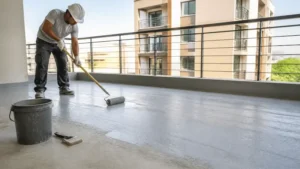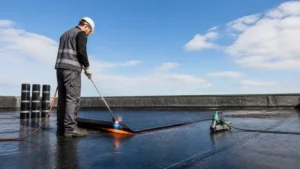
Few materials in the building envelope have a track record as long as PVC. A PVC waterproofing membrane is a single-ply sheet made from plasticized polyvinyl chloride, and it has protected low-slope roofs, tunnels, pools, and industrial facilities for more than half a century. In this article, we walk through the properties that make the PVC waterproofing membrane so reliable, explain how its seams are welded, and identify the projects where it outperforms every alternative.
What Is a PVC Waterproofing Membrane?
At its core, a PVC waterproofing membrane is a factory-manufactured sheet of polyvinyl chloride resin combined with plasticizers, stabilizers, UV inhibitors, and a reinforcing scrim — usually polyester or fiberglass — that is embedded in the core for dimensional stability. The plasticizers give the sheet its flexibility, which means it can absorb building movement without cracking. Furthermore, the scrim reinforcement controls elongation, so the membrane resists puncture and tear far better than an unreinforced sheet.
For a wider overview of how PVC compares with other membrane families, our Ultimate Guide to Waterproofing Membranes is a useful starting point before you shortlist materials.
Key Properties of a PVC Waterproofing Membrane
The popularity of PVC comes from a combination of properties that few single-ply materials match in a single product:
| Property | What It Means in Practice |
|---|---|
| Waterproofing | A continuous, seam-welded barrier with no exposed fasteners |
| Chemical resistance | Resists oils, greases, solvents, and many industrial chemicals |
| Fire retardance | Inherently self-extinguishing; simplifies code compliance |
| Flexibility | Stays flexible in cold weather and follows substrate movement |
| Weldability | Seams are fused with hot air, creating bonds stronger than the sheet |
| Mold and algae resistance | Maintains a clean appearance and protects the roof system |
| Puncture and tear resistance | Reinforced scrim absorbs impact and foot traffic |
| Lifespan | 20–30+ years with proper installation and maintenance |
Importantly, the fire-retardant and chemical-resistant character of PVC is a genuine differentiator. Consequently, in environments where oils and solvents regularly contact the roof — kitchens, processing plants, and warehouses — PVC is frequently the only single-ply option that holds up.
Hot-Air Welding: How PVC Seams Are Made
Unlike bitumen membranes, which rely on torches or adhesives, PVC is joined with hot-air welding. The installer runs a welding machine or handheld gun along the overlapped seam, heating both sheets to their melting point and fusing them into a single piece of material. As a result, the welded seam is typically stronger than the membrane itself, which eliminates the most common failure point of any roof — the joint.
A few practical points to remember:
- The overlap width and weld temperature must match the membrane’s formulation and the ambient conditions.
- After welding, seams should be tested — a probe or peel test confirms the bond is continuous.
- Details such as pipe flashings, corners, and terminations should be welded with the same process, never with sealant alone.
In practice, the weldability of PVC is one of its greatest advantages, because it allows complex geometry — parapets, penetrations, and curbs — to be sealed with the same guaranteed joint as the main field.
Best Applications for the PVC Waterproofing Membrane
The PVC waterproofing membrane earns its place in a distinct set of applications where chemical resistance, fire performance, and weldability matter most:
- Low-slope and commercial roofing — the classic application, particularly for buildings with complex rooftop geometry.
- Underground structures and tunnels — where the membrane is welded into a continuous watertight envelope against hydrostatic pressure.
- Swimming pools and water features — PVC handles continuous water contact and chlorine without degradation.
- Chemical and food-processing facilities — oils, greases, and aggressive cleaning agents are no match for PVC’s chemical resistance.
- Bridges and civil engineering — where a durable, flexible, and weldable barrier is required on concrete decks.
- Saline and coastal zones — PVC resists salt exposure better than many alternatives.
For a comparison of PVC and TPO in roofing applications, our earlier articles on the Key Differences Between PVC and TPO Waterproof Membranes and the TPO vs PVC pros, cons and selection guide will help you draw the boundary between the two materials.
What to Verify When Sourcing a PVC Membrane
Not all PVC membranes are created equal, and the formulation determines the lifespan. The ASTM D4434 standard classifies PVC roof membranes into types based on the plasticizer system and performance, and manufacturers such as Sika Sarnafil publish detailed system specifications. When you evaluate suppliers, check the following:
- Membrane thickness over the scrim, not just total thickness.
- The plasticizer type — premium plasticizers resist migration and embrittlement.
- Scrim reinforcement and its tensile strength.
- Third-party test reports for weathering, fire, and chemical resistance.
- The manufacturer’s track record and warranty terms.
As a rule, the cheapest PVC is rarely the best value, because low-cost plasticizer systems fail years earlier. Notably, at Huafeng Waterproof, our puncture-proof membrane range includes reinforced single-ply options engineered for demanding projects, and our team can supply test reports and samples before you commit to a full order.
The Bottom Line
A PVC waterproofing membrane remains one of the most dependable choices for projects that demand chemical resistance, fire performance, and strong welded seams. If your building sits in a harsh chemical, coastal, or high-moisture environment — or if your roof has complex geometry that needs flawless detailing — PVC deserves a place at the top of your shortlist.
Ready to compare specifications for your project? Contact our team for a free quote, and we will help you select the right membrane, thickness, and reinforcement for your building.