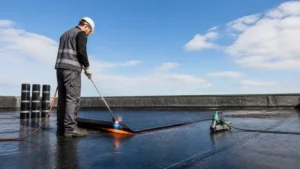
Bathrooms and balconies are the two most common leak points in any building — and the two areas where a proper waterproofing layer saves the most money. For these wet zones, JS waterproof coating has become the standard choice for contractors worldwide. It is a polymer cement-based coating that cures into a seamless, flexible membrane, and it bonds directly to concrete and tile substrates. In this guide, we explain what JS waterproof coating is, why it suits bathrooms and balconies, and exactly how to apply it so the result passes the flood test the first time.
What Is JS Polymer Cement Waterproof Coating?
JS (polymer–cement, from the Chinese jushui abbreviation) coating is a two-component, water-based system: one component is a polymer emulsion — typically acrylate or vinyl acetate-ethylene — and the other is a powder of cement and fine fillers. When the two are mixed, the cement hydrates while the polymer film forms, producing a tough yet elastic waterproof membrane.
Moreover, because the coating is water-based, it is low-odor, non-toxic, and safe for indoor use — a decisive advantage in occupied bathrooms where solvent-based systems are impractical. As a result, JS coatings are widely specified for interior wet areas, balconies, kitchens, and rooftops across residential and commercial projects. For a broader comparison of coating and membrane systems, see our Ultimate Guide to Waterproofing Membranes.
Key Properties at a Glance
| Property | What It Means in Practice |
|---|---|
| Seamless membrane | No laps or joints to fail, unlike sheet membranes |
| Strong adhesion | Bonds to concrete, mortar, and existing tiles |
| Flexibility | Bridges hairline cracks caused by building movement |
| Water-based | Low odor, non-toxic, safe for indoor application |
| Tiling compatibility | Ceramic tiles bond directly over the cured coating |
| Durability | Resists aging, wear, and water immersion |
| Easy application | Roller, brush, or trowel — no special equipment |
In particular, the combination of adhesion and flexibility is what makes JS coating reliable in bathrooms, where floors and walls move slightly under load and temperature changes.
Why Bathrooms and Balconies Need It
Bathrooms are constantly wetted, and their floors sit directly above living spaces — a single failed joint means a stained ceiling below. Balconies, on the other hand, face rain, UV, and freeze-thaw cycles, all while supporting heavy foot traffic. JS waterproof coating handles both conditions well:
- It forms a continuous barrier with no seams, eliminating the lap failures typical of sheet membranes.
- It bonds to the substrate, so water cannot travel laterally under the coating.
- It is compatible with tile adhesive, which means the waterproofing layer sits invisibly under the finished floor.
For balconies exposed to the weather, a protective screed or tile layer over the coating extends service life considerably.
Step-by-Step Application Guide
Follow these steps carefully — the quality of the final waterproofing depends on the preparation as much as on the material.
- Prepare the substrate. The surface must be sound, clean, and free of dust, oil, and loose material. Fill cracks and level hollow areas first. Moisture content should be low, with no standing water.
- Reinforce the critical points. Apply a first strip of coating at corners, drains, and pipe penetrations, and bed a strip of fiberglass mesh into the wet coating. These are the highest-risk zones.
- Mix the two components. Add the powder to the liquid gradually while stirring, and mix until no lumps remain. Use the full bag — partial mixes upset the ratio.
- Apply the first coat. Use a roller or brush to spread the coating evenly at the specified thickness. Do not spread it too thin in an attempt to save material.
- Apply the second coat. Once the first coat is touch-dry (usually 4–6 hours), apply a second coat perpendicular to the first. Two thin coats outperform one thick coat, which tends to crack while curing.
- Cure properly. Keep the coated surface damp or protected for 24–48 hours, and avoid foot traffic and water contact during curing.
- Flood test. For bathrooms, seal the drain and hold water 20–30 mm deep for 24–48 hours. Check the room below and the adjacent walls. Only after a dry test should you tile over the coating.
For a step-by-step refresher with mixing ratios and coverage rates, the BOSLAI JS waterproof coating application guide and the JS polymer cement coating application walkthrough both cover the practical details in depth.
Common Mistakes to Avoid
Even good coating fails when applied incorrectly. These are the most frequent errors seen on site:
- Wrong mix ratio — either component added by eye instead of by weight.
- One thick coat — curing shrinkage cracks the membrane.
- Skipping corner reinforcement — mesh is omitted at drains and angles, where leaks start.
- Coating a damp or dusty surface — adhesion fails and the film peels.
- Walking on the fresh coating — traffic punctures or lifts the film.
- Tiling too early — the coating is not fully cured, and tile adhesive pulls it off.
- Ignoring the flood test — defects are discovered after tiling, when repair is expensive.
In practice, most of these mistakes are avoidable with a short pre-job briefing — the extra 30 minutes of care saves weeks of remedial work.
Coating vs Membrane: Which Fits Where
JS coating and sheet membranes each have their place. Membranes offer factory-controlled thickness and fast coverage on large flat roofs, while coatings excel on small areas, complex geometry, and vertical surfaces. Consequently, many projects use both: membranes on the main roof field, and JS coating on bathrooms, balconies, parapets, and detail zones. Our Ultimate Guide to Waterproofing Membranes compares the options in detail if you are planning a hybrid system.
Sourcing Quality JS Coating
The performance of JS waterproof coating depends heavily on the polymer content — cheap formulations use too little emulsion and crack after a season. When sourcing, check the solid content, the elongation at break, the adhesion rating, and the applicable standard for your market.
At Huafeng Waterproof, our polymer cement-based JS waterproof coating is formulated for anti-aging and wear resistance, and it is available through our full waterproof coating range with test reports and samples on request.
The Bottom Line
JS waterproof coating is the most reliable, cost-effective way to waterproof bathrooms and balconies — provided it is mixed correctly, applied in two thin coats, and flood-tested before tiling. Follow the steps above, avoid the common mistakes, and the coating will outlast the tiles above it.
Planning a bathroom or balcony project and need coating specifications? Contact our team for a free quote — we will help you calculate the quantity, coverage, and budget for your job.