When a commercial roof needs replacing, few decisions carry more weight than the membrane choice. TPO vs PVC is one of the most debated comparisons in the roofing industry, and for good reason: both are single-ply membranes with heat-welded seams, yet each serves a different set of project conditions. This TPO vs PVC guide breaks down the technical differences, the real-world trade-offs, and the selection criteria you should apply before you issue a specification.
What Is a Single-Ply Roofing Membrane?
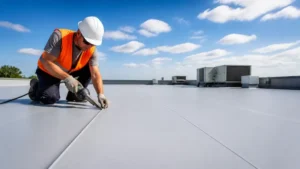
Before we dig into the TPO vs PVC question, it helps to define the category itself. A single-ply membrane is a factory-manufactured sheet, typically 1.1–2.0 mm thick, installed in a single layer over the roof substrate. In contrast to built-up or modified bitumen systems, single-ply membranes rely on the sheet itself for waterproofing, and their seams are fused with hot-air welding rather than torches or adhesives. For a broader comparison of membrane families, see our Ultimate Guide to Waterproofing Membranes, which covers bitumen, TPO, PVC, and coating options side by side.
TPO Membrane: The Modern All-Rounder
Thermoplastic polyolefin (TPO) is a single-ply membrane made from a blend of polypropylene and rubber. Because it contains no plasticizers, the material stays flexible without the risk of plasticizer migration over time. Moreover, TPO is famous for its energy performance: the white surface reflects solar heat, which lowers cooling loads and helps buildings earn green-building credits.
Key strengths of TPO:
- Excellent UV and ozone resistance.
- Heat-welded seams that are often stronger than the sheet itself.
- Good low-temperature flexibility.
- Competitive cost compared with other single-ply options.
- Fully recyclable at the end of its service life.
For longevity data and what affects the service life in practice, read our earlier analysis on The Lifespan of TPO Waterproofing Membrane.
PVC Membrane: The Chemical-Resistant Workhorse
Polyvinyl chloride (PVC) membranes, on the other hand, are plasticized for flexibility and have one of the longest track records in commercial roofing. Their most valuable advantage is chemical resistance: PVC handles oils, greases, and many industrial chemicals that would degrade other membranes. Consequently, PVC is frequently the first choice for food-processing plants, restaurants, chemical facilities, and other aggressive environments. PVC also offers inherent fire retardance, which can simplify compliance with strict building codes.
Key strengths of PVC:
- Superior resistance to oils, greases, and chemicals.
- Inherent fire retardance.
- Proven performance over decades of installations.
- Strong puncture and tear resistance.
The trade-off is that PVC relies on plasticizers, and the formulation matters a great deal: high-quality PVC with premium plasticizers resists embrittlement, while low-cost formulations can stiffen and crack as the plasticizers migrate.
TPO vs PVC: Head-to-Head Comparison
Now that both materials are on the table, here is the practical TPO vs PVC comparison you need for specification:
| Attribute | TPO Membrane | PVC Membrane |
|---|---|---|
| Composition | Polyolefin blend, plasticizer-free | Plasticized PVC |
| UV & weathering resistance | Excellent | Very good |
| Chemical & oil resistance | Good | Superior |
| Fire resistance | Good | Excellent (inherent) |
| Seam integrity (heat welding) | Excellent | Excellent |
| Low-temperature flexibility | Good | Very good |
| Relative cost | Lower | Higher |
| Typical lifespan | 20–30 years | 20–30+ years |
| Sustainability | Recyclable, no plasticizers | Recyclable, chlorine-based |
As the table shows, both membranes deliver strong seam integrity and long service life. However, the decisive factors are almost always the environment, the budget, and the building’s specific risk profile.
How to Choose: Key Selection Factors
There is no universal winner in the TPO vs PVC debate; instead, match the membrane to the project. Consider the following factors in order:
- Chemical exposure. If the roof serves a kitchen, warehouse, chemical plant, or any facility where oils and solvents touch the roof, choose PVC for its chemical resistance.
- Heat and UV load. In hot, sunny climates, TPO’s reflective surface and UV resistance make it a cost-effective, energy-efficient choice.
- Fire-rating requirements. Where local codes demand enhanced fire performance, PVC’s inherent retardance can reduce the need for additional protection layers.
- Budget. TPO generally offers a lower installed cost. As a result, for large, low-risk warehouses and distribution centers, TPO is often the value champion.
- Sustainability goals. If the project pursues LEED or similar certification, TPO’s plasticizer-free, recyclable formulation is a strong talking point.
For a deeper look at how these materials behave on industrial buildings, you can also review our post on How to Choose the Right Waterproofing Solution for Industrial Roofs.
Sourcing Quality Membranes: What to Verify
Whichever membrane you select, quality varies significantly between manufacturers. Always verify the sheet thickness, the scrim reinforcement, the published performance data, and third-party certifications before purchasing. For example, the NRCA’s thermoplastic roofing guidelines describe how thermoplastic membranes should be specified and tested, while manufacturers such as Elevate and Sika Sarnafil publish detailed material comparisons that are worth reviewing before you shortlist suppliers.
At Huafeng Waterproof, we manufacture TPO membranes with heat-welded seams, reinforced scrim, and consistent roll-to-roll quality for export markets. Our TPO waterproof membrane is available in custom widths and thicknesses to match your project’s structural and performance requirements, and our custom TPO options support OEM and ODM programs for distributors and roofing contractors.
The Bottom Line
In the TPO vs PVC debate, the right answer always depends on the building: choose TPO for cost-efficient, UV-exposed, low-chemical roofs with sustainability goals; choose PVC for chemically aggressive environments and strict fire-rating requirements. Whichever direction you take, insist on verified specifications and a supplier with a documented quality system.
Need help sizing a single-ply system for your next project? Contact our team for a free quote — we will help you compare the numbers and pick the membrane that fits your roof and your budget.